


 Luxury Tour Luxury Tour Private & Historical tour in Egypt
  Private & Historical tour in Egypt
  Family Vacation Packages
  Family Vacation Packages
  Private & Historical tour in Egypt
  Nile Cruise Tour
  Private & Historical tour in Egypt
  Private & Historical tour in Egypt
  All inclusive
  Adventure Tour
  Private & Historical tour in Egypt
  Adventure Tour
  Private & Historical tour in Egypt
  Christmas Tour
  Private & Historical tour in Egypt Family Vacation Packages
  Food Tour
  Private & Historical tour in Egypt
  Private & Historical tour in Egypt
  Private & Historical tour in Egypt
  Cheap Egypt Tours & Budget Packages
  Egypt Classic Tour Packages
  Private & Historical tour in Egypt
  Wheelchair Tours
  Private & Historical tour in Egypt
  All inclusive
  Adventure Tour
  Adventure Tour
  Private & Historical tour in Egypt
  Private & Historical tour in Egypt
  Private & Historical tour in Egypt
  Private & Historical tour in Egypt
  Private & Historical tour in Egypt
  Private & Historical tour in Egypt
  Private & Historical tour in Egypt
 Pompey’s Pillar is one of the most famous monuments in Alexandria and a must-visit landmark for anyone touring Egypt. Standing majestically on a rocky plateau, this towering structure offers a glimpse into the city’s rich Roman heritage.
Below, we explore the history, myths, and architectural facts behind this ancient wonder.
If you are wondering what is Pompey’s Pillar, it is a massive Roman triumphal column constructed from a single block of red Aswan granite. It is historically significant as the last surviving remnant of the Serapeum Temple, a magnificent sanctuary dedicated to the god Serapis, which was once one of the most important religious centers in the ancient world.
The column is often cited as one of the tallest ancient monolithic columns ever erected, making it an engineering marvel of its time.
Where is Pompey’s Pillar located exactly? The monument stands on the Bab Sidra hill in Alexandria, situated between the current Muslim burial area (known as the Column Tombs) and the famous Kom el Shoqafa plateau. Its elevated position makes it visible from various points in the city, standing as a silent sentinel over modern Alexandria.
Historical records indicate that the column was erected in honor of the Roman Emperor Diocletian. But when was Pompey’s Pillar built? It dates back to the Roman era, specifically the 3rd century AD (approximately 297 AD).
It was built to commemorate Diocletian’s victory over an Alexandrian revolt. An inscription at the base of the column honors him, though the popular name “Pompey’s Pillar” suggests a different, more mythical history.
The name is actually a historical misnomer dating back to the Crusades.
The European Myth: Crusaders and European travelers mistakenly believed that the head of the Roman general Pompey—who fled to Egypt to escape Julius Caesar and was subsequently killed—was placed in a funerary urn atop the column’s capital. Thus, they named it “Pompey’s Pillar.”
The Arabic Name: In the Arabic era, the column was known as Amoud el-Sawari (Column of the Masts). Due to its towering height among 400 other smaller columns in the original temple complex, it resembled the main mast of a giant ship.
Interestingly, during the Byzantine era, it was also briefly referred to as the “Theodosian Column” due to religious shifts in the region, with some accounts suggesting it was rededicated to Christianity after the destruction of the pagan Serapeum.
The structure is an architectural masterpiece. Here are the key facts:
Material: The column is made of solid red granite brought from the quarries of Aswan.
Dimensions: The body of the column is a single monolithic piece. It measures 2.70 meters in diameter at the base and tapers to 2.30 meters at the crown.
Total Height: Including the base and the capital, the total height is approximately 26.85 meters.
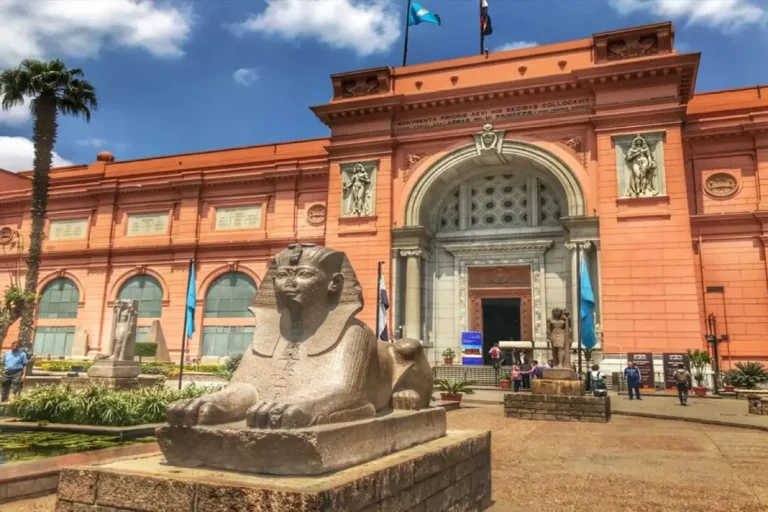
The Sphinxes: On the western side of the column, visitors can see two sphinx statues made of pink granite. These date back to the era of Ptolemy VI. One of them bears an inscription of King Horemheb of the 18th Dynasty, linking the site to Pharaonic history as well.
The Site: The column was built on slopes that were originally part of the Serapeum Temple complex. Visitors can also explore subterranean galleries and the remains of the temple foundations nearby.
Location: Pompey’s Pillar Alexandria (near Kom el Shoqafa).
Significance: The tallest ancient monument in Alexandria and the last remnant of the Serapeum.
Best View: The site offers a panoramic view of the city due to its location on the highest hill in the old district.
Pompey’s Pillar is a monumental Roman triumphal column made from a single block of red Aswan granite. It is historically significant as the last remaining structure of the ancient Serapeum Temple, once a major religious center dedicated to the god Serapis in Alexandria.
Pompey’s Pillar is located on Bab Sidra hill in Alexandria, Egypt. It stands between the Column Tombs (a Muslim burial area) and the Kom el Shoqafa archaeological site, making it one of the most visible ancient landmarks in the city.
Pompey’s Pillar was built in the late 3rd century AD, around 297 AD, during the Roman era. The column was erected in honor of Emperor Diocletian to commemorate his victory over an Alexandrian revolt.
The name “Pompey’s Pillar” comes from a medieval European myth. Crusaders mistakenly believed the Roman general Pompey’s remains were placed atop the column, even though the monument was actually dedicated to Emperor Diocletian and has no historical connection to Pompey.
Pompey’s Pillar is carved from solid red granite quarried in Aswan. The column stands approximately 26.85 meters tall, including its base and capital, and is considered one of the tallest ancient monolithic columns ever constructed.
Visitors to Pompey’s Pillar can explore the towering column, two ancient granite sphinx statues, subterranean galleries, and the remains of the Serapeum Temple complex. The elevated site also offers panoramic views over historic Alexandria.
Build your own private tour to Egypt — one detail at a time.