


 Private & Historical tour in Egypt
 5 Days Cairo Tour From Singapore
from$1,700.00
Private & Historical tour in Egypt  Private & Historical tour in Egypt
  Private & Historical tour in Egypt
  Private & Historical tour in Egypt
  Private & Historical tour in Egypt
  Private & Historical tour in Egypt
  Private & Historical tour in Egypt Family Vacation Packages
  Private & Historical tour in Egypt
  Private & Historical tour in Egypt
  Private & Historical tour in Egypt
  Private & Historical tour in Egypt
  Family Vacation Packages
  Nile Cruise Tour
  Egypt Classic Tour Packages
  Private & Historical tour in Egypt
  Private & Historical tour in Egypt
  Private & Historical tour in Egypt
  Family Vacation Packages
  Private & Historical tour in Egypt
  Private & Historical tour in Egypt
  Family Vacation Packages Private & Historical tour in Egypt
  Nile Cruise Tour
  Private & Historical tour in Egypt
  Nile Cruise Tour Private & Historical tour in Egypt
  Easter Holiday
  Nile Cruise Tour
  Nile Cruise Tour
  Nile Cruise Tour
  Christmas Tour
  Christmas Tour
  Private & Historical tour in Egypt Private & Historical tour in Egypt
  Family Vacation Packages
 Nestled on the west bank of the Nile between Luxor and Aswan, the Temple of Edfu is one of the most breathtaking stops on any Egyptian vacation. Known in Greco-Roman times as Apollonopolis Magna, this extraordinary monument is dedicated to Horus, the falcon-headed god of the sky — and it remains the best-preserved temple in all of Egypt.
Standing as the second largest temple in Egypt after Karnak, Edfu is an unmissable destination for history lovers, culture seekers, and first-time visitors alike. Whether you’re joining a classic Nile cruise or a private guided Egypt tour, a visit to this awe-inspiring sanctuary is always a highlight.
Construction of the Temple of Edfu began in 237 BC during the Hellenistic period, under the reign of Ptolemy III, following Alexander the Great’s conquest of Egypt. Though its rulers were Greek, the Ptolemaic dynasty preserved the ancient Egyptian architectural style and religious traditions with remarkable devotion.
The temple took nearly 180 years to complete, finally being finished in 57 BC under Ptolemy XII. It was built upon the foundations of a much older, smaller sanctuary also dedicated to Horus — a testament to the site’s deep spiritual significance stretching back to the earliest dynasties of Egypt.
Ancient records even suggest that the legendary architect Imhotep, designer of the Step Pyramid of Saqqara, once built an earlier temple at this sacred site.
The Great Pylon — At 37 meters tall, this towering entrance is one of the tallest pylons in Egypt. Its walls are carved with dramatic reliefs depicting Ptolemy XII — known as Neos Dionysus — vanquishing his enemies before the great Horus.
The Forecourt & Sacrificial Courtyard — Beyond the pylon lies a grand open courtyard where ancient Egyptians once gathered to make offerings. Today, visitors can walk the same stones and marvel at the towering colonnade surrounding it.
The Statue of Horus — At the entrance stands an iconic granite statue of Horus as a falcon, one of the most photographed images in all of Egypt.
The House of the Nativity (Mammisi) — A distinctive Greco-Roman structure to the left of the entrance, this cylindrical building hosted the annual coronation ceremonies representing the divine births of both Horus and the reigning pharaoh.
The Inner Sanctuary — Deep within the temple lies the holy of holies, where a granite shrine once housed the golden statue of Horus. The rear walls bear a beautiful relief of Horus nursing Isis, among the most moving images in the complex.
The Protective Enclosure Wall — Surrounding the entire temple is a 13-meter-high mud brick wall symbolizing the primordial waters of creation. The Egyptians believed the temple represented the first land to emerge from chaos — the very foundation of the world.
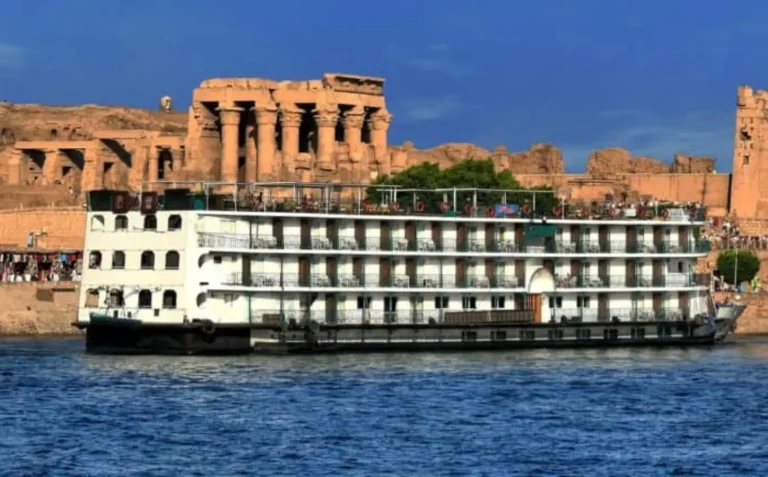
The temple is located 120 km from both Luxor and Aswan, making it a natural midpoint stop on any Nile cruise itinerary. When your cruise ship docks, you can reach the temple by horse-drawn carriage or rickshaw from the riverbank — a charming experience in itself.
Our Egypt tours include guided visits to Edfu with expert Egyptologist guides who will bring the temple’s ancient myths and royal history to life. If you’re planning a trip that combines the Nile cruise with visits to Kom Ombo, Philae, Karnak, and the Valley of the Kings, Edfu will undoubtedly be a crown jewel of your journey.
👉 Browse our Egypt tours that include the Temple of Edfu below.
The Temple of Edfu is located on the west bank of the Nile River in Upper Egypt, in the city of Edfu. It sits approximately 120 km from both Luxor and Aswan, making it a central stop on Nile cruise itineraries.
Construction was initiated by Ptolemy III in 237 BC and completed by Ptolemy XII in 57 BC. Though the Ptolemaic rulers were of Greek origin, they maintained traditional Egyptian architecture and religious customs throughout the temple's construction.
The Temple of Edfu is dedicated to Horus, the ancient Egyptian falcon-headed god of the sky and kingship. The city of Edfu was known as the cult center of Horus, also worshipped here as "Horus Behedet."
The Temple of Edfu is considered the best-preserved temple in all of Egypt. Much of it was buried under desert sand for centuries, which protected it from erosion and damage. It was excavated in the 19th century by the French Egyptologist Auguste Mariette.
Most Nile cruise ships dock at the port of Edfu, from where visitors travel to the temple by horse-drawn carriage or rickshaw. Many Egypt tour packages include this transfer as well as a guided tour of the temple itself.
A thorough guided visit to the Temple of Edfu typically takes between 1.5 to 2.5 hours. This allows time to explore the pylon, courtyard, hypostyle halls, inner sanctuary, and surrounding enclosure wall.
Yes! The Temple of Edfu can be visited as a day trip from Luxor or Aswan by private car, minibus, or organized tour. Many of our Egypt vacation packages offer flexible itineraries that include Edfu as a standalone excursion or as part of a broader Upper Egypt tour.
Build your own private tour to Egypt — one detail at a time.