


 Alexandria Day Tours
 El Alamein Day Tour from Alexandria
from$75.00
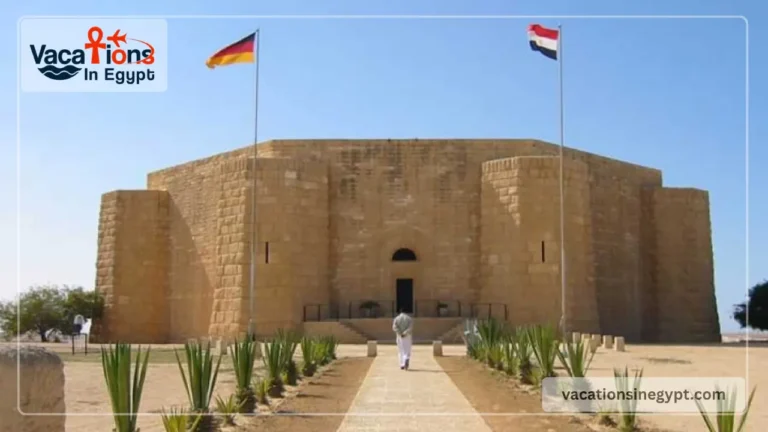
Alexandria Day Tours Memorial German Military El Alamein also known as the “German Cemetery”, is located in the Tel al-Eis area overlooking the Mediterranean Sea and contains the remains of more than 4,200 German soldiers who died in the Second World War.
The German cemetery was built in the form of a castle and is divided into eight rooms, with seven rooms each containing 600 soldiers, while the eighth room contains 80 unidentified soldiers.
In 1956, the German government decided to build a special cemetery for the Germans, and the remains of the German soldiers were transferred to the German cemetery, where each soldier’s name, date of birth and date of death were recorded and there is a memorial plaque on which this is recorded.
In the middle of the German cemetery, a pharaonic obelisk with straight falcons painted on it is said to symbolise eternity and to signify that those who died away from their homeland died and were buried in a country that reveres the dead for thousands of years, and that this obelisk takes the German dead under its protection, and it is written on the obelisk “Rest 4200 German soldiers in World War II, their death is a recommendation and warning to us”, and on the other side of the obelisk, the phrase .. and respect life” is written.
The German Memorial is an ossuary, meaning it houses remains within a single, central structure rather than individual graves spread across a field. Architecturally, it is designed as an octagonal stone fortress, modeled after the Castel del Monte in Italy, symbolizing a collective "castle of the dead."
It is located on a hill north of the main Alexandria-Marsa Matrouh road, roughly 115 kilometers west of Alexandria. Its elevated position offers a stark view of the Mediterranean Sea and the surrounding desert battlefields.
Generally, there is a small entry fee for foreign tourists (usually paid in Egyptian Pounds). It is managed by the German War Graves Commission (Volksbund), and the funds go toward the upkeep and preservation of the site.
Yes. Inside the central courtyard, there are bronze plaques and stone tablets inscribed with the names of the identified soldiers. There is also a small chapel area for reflection and a central obelisk that stands as a tribute to the fallen.
The site is typically open daily from 9:00 AM to 4:00 PM. However, hours can shift during local holidays or Ramadan, so it is always wise to check with a local guide or tour operator if you are traveling from Cairo or Alexandria.
Build your own private tour to Egypt — one detail at a time.