


 Cheap Egypt Tours & Budget Packages
 Unforgettable Budget Tour to Cairo
from$900.00
Cheap Egypt Tours & Budget Packages  Adventure Tour
  Private & Historical tour in Egypt
  Private & Historical tour in Egypt
  Private & Historical tour in Egypt
  Sightseeing Tour
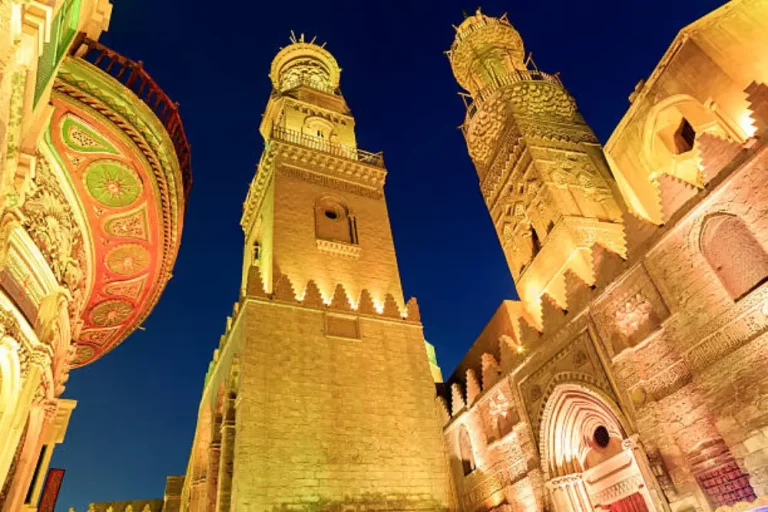
 The Mosque of Sultan Hassan is widely regarded as the finest piece of early Mamluk architecture in Cairo. Massive, imposing, and intricately detailed, it is often cited by historians as one of the most significant Islamic monuments in the world.
Originally designed as a Madrasa (a school dedicated to Islamic teachings) and a congregational mosque for Friday sermons, it has stood for centuries as a testament to the grandeur of Egypt’s history. With an area of nearly 8,000 square meters, it is one of the largest mosques in existence.
If you are visiting the Egyptian capital, admiring the beauty of this monument is a must-do.
Traveler Tip: Try to visit in the morning. The mausoleum was architecturally designed so that the rays of dawn flood the entire enclosure, creating a spiritual and photogenic atmosphere.
Construction of this jewel of Islamic art began in 1356 (during the mid-14th century). A site was chosen on one of the highest points near the Citadel of Saladin, offering one of the best panoramic views in Cairo.
However, the story of its construction is dramatic and tragic. The mosque was commissioned by Sultan Hassan, a ruler who ascended the throne twice—first at age 13 (when he was deposed), and again in 1356. While he is responsible for this magnificent structure, he never saw it completed due to strange and violent circumstances.
There are two historical versions surrounding the Sultan’s demise, often linked to the mosque itself. The most widespread story involves a tragic accident. During construction, one of the massive minarets collapsed, killing approximately 300 people (orphans and students). This catastrophe was interpreted by the public as a “bad omen” and a divine message against the Sultan.
The rumors of doom spread quickly. Just 33 days after the fall of the minaret, Sultan Hassan was assassinated in 1361.
The second account of the Sultan’s death relates to political corruption and the exhaustion of the workforce—it is said Hassan ordered that work continue without a single day of rest. By placing his favorites in powerful positions, he angered the established Mamluk elite. A plot was hatched by his own commander-in-chief, Yalbugha al-Umari, a man the Sultan mistakenly thought was loyal.
It was not until two years after the Sultan’s death that the mosque was finally completed by one of his officials, Bashir Al Gamdar.
The construction supervisor, Prince Muhammad bin Baylik, oversaw a project of enormous proportions.
The Sultan Hassan Mosque Cairo introduced several architectural innovations that changed mosque design in the Arab world:
The mosque is located in the El-Qalaa square, directly next to the Al-Rifai Mosque. Because they sit side-by-side, they are almost always visited together.
The Mosque of Sultan Hassan is famous for being the finest example of early Mamluk architecture in Cairo and one of the most important Islamic monuments in the world, known for its massive scale and innovative design.
Construction of the Mosque of Sultan Hassan began in 1356 AD during the mid-14th century and was completed two years after the Sultan’s death, around 1363 AD.
The mosque was originally designed as both a congregational mosque for Friday prayers and a madrasa, with four separate schools dedicated to the four Sunni Islamic legal traditions.
Sultan Hassan was assassinated in 1361, before the mosque was completed. His death is often linked to political intrigue and a tragic minaret collapse that was viewed as a bad omen.
The mosque introduced revolutionary features, including a large egg-shaped dome, an unprecedented mausoleum placed behind the qibla wall, and an ambitious plan for four minarets, which had never been attempted before.
The mosque is located in El-Qalaa Square, directly next to Al-Rifai Mosque, below the Citadel of Saladin. The easiest way to reach it is by taxi or ride-hailing services like Uber or Careem.
Build your own private tour to Egypt — one detail at a time.