
Karnak Temple

Standing on the east bank of the Nile in Luxor, the Temple Complex of Karnak represents the pinnacle of ancient Egyptian architectural achievement and religious devotion. This colossal sacred city—covering more than 2 square kilometers and capable of containing ten European cathedrals—served as Egypt's most important place of worship for over 1,500 years. Today, it remains the largest religious building ever constructed and one of humanity's most awe-inspiring archaeological wonders.
A Monument Built Across Millennia
Unlike the pyramids, which were built within decades, Karnak evolved continuously over fifteen centuries, with successive pharaohs adding, expanding, and embellishing the complex from approximately 2000 BCE through the Ptolemaic period and into early Christian times. This makes Karnak not just a temple, but a living chronicle of ancient Egyptian civilization carved in stone.
The Middle Kingdom Foundation (2000-1570 BCE)
The oldest structures at Karnak date to the Middle Kingdom, specifically the 12th Dynasty. The White Chapel of Sesostris I (1965-1920 BCE), beautifully reconstructed in the open-air museum, showcases the refined artistry of this early period. Archaeological excavations have also revealed the foundations of the original 12th Dynasty Temple of Amun beneath later constructions in the sanctuary of the sacred boat and the Courtyard of the Middle Kingdom, located behind the sixth pylon.
These Middle Kingdom remains provide fascinating glimpses into Karnak's origins, though most are now fragmentary. The Courtyard of the Middle Kingdom, while containing only ruins today, represents the sacred core from which the massive complex would eventually grow.
The New Kingdom Glory (1570-1090 BCE)
The structures that dominate Karnak today—and inspire awe in millions of visitors—were primarily built during Egypt's most powerful era: the New Kingdom, specifically the 18th to 20th Dynasties (1570-1090 BCE). During this golden age, Egypt's mightiest pharaohs spent vast fortunes to leave their eternal mark on the holiest of places.
Pharaohs like Hatshepsut, Thutmose III, Amenhotep III, Seti I, and Ramesses II competed to outdo their predecessors, adding halls, pylons, obelisks, and sanctuaries that grew progressively more magnificent. Amenhotep III, in particular, made massive contributions during the New Kingdom that shaped much of what visitors see today.
As you walk deeper into the complex, you're literally walking backward through time—the further you penetrate toward the interior, the older the structures become, creating a unique archaeological experience where architecture serves as a timeline.
Later Additions and Christian Influence
Even after the New Kingdom's decline, later pharaohs, the Ptolemaic rulers of Greek descent, and early Christians continued to modify Karnak. The Great Open Courtyard, for instance, was added during the 22nd Dynasty, demonstrating that Karnak remained religially significant for centuries after its golden age.
The Sacred Purpose: Home of the Gods
Karnak was far more than a temple in the conventional sense—it was an extraordinary complex of shrines, sanctuaries, kiosks, pylons, and obelisks dedicated to the Theban gods and constructed for the greater glory of Egypt's pharaohs. Understanding its purpose helps visitors appreciate the meaning behind its overwhelming scale.
The Temple of Amun-Re: The Heart of Karnak
The massive Temple of Amun-Re forms the complex's centerpiece and is the largest religious building ever constructed. Amun-Re, the king of gods and patron deity of Thebes, was believed to reside here on Earth in his sacred sanctuary. The temple served as the god's earthly palace, where priests performed daily rituals to sustain cosmic order and ensure Egypt's prosperity.
The temple's design reflects Egyptian cosmology: proceeding from the vast open courtyard (representing the world of humans) through progressively darker and more restricted halls, finally reaching the intimate sanctuary where only the pharaoh and high priests could commune with the divine presence—a journey from the mortal realm toward the eternal.
The Theban Triad: Family of Gods
Surrounding the Temple of Amun are separate temple complexes dedicated to his divine family. Mut, Amun's wife and powerful goddess in her own right, has her own temple precinct connected by a processional avenue. Their son Khonsu, the moon god, likewise has a beautifully preserved temple within the enclosure.
This arrangement reflects Egyptian religious belief that gods, like humans, lived in family units. The three deities—Amun, Mut, and Khonsu—formed the Theban Triad, the divine guardians of Thebes who rose to national prominence when Thebes became Egypt's capital during the New Kingdom.
The Opet Festival: When Gods Walked Among Men
Karnak's most important function was hosting the annual Opet Festival, when statues of the Theban Triad were carried from Karnak to Luxor Temple in a magnificent procession. The triple chapels of Seti II in the northwest corner of the Great Court served as resting stations for the sacred boats during this journey, where priests would pause to perform rituals before the divine images.
These gray sandstone chapels, each dedicated to one member of the Theban Triad, beautifully illustrate the festival's importance. The central chapel honored Amun-Re, with its facade carved with the winged solar disk and originally inscribed with King Seti II's cartouches (later erased because they contained the name of the god Seth). Interior reliefs show the king burning incense before Amun's sacred boat and offering perfume to the divine triad.
The Hypostyle Hall: Forest of Giants
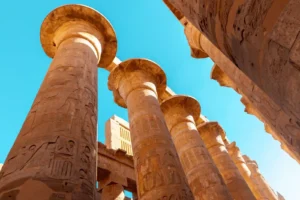
No visit to Karnak is complete without experiencing the Great Hypostyle Hall—one of humanity's most breathtaking architectural achievements. This massive columned hall creates the impression of walking through a stone forest where trees have been replaced by towering pillars adorned with hieroglyphs and colorful reliefs.
The Numbers Tell the Story
Researchers have documented 134 columns in total within the Hypostyle Hall, arranged in carefully planned rows that create dramatic visual effects. The twelve central columns, supporting the hall's highest section, soar to 70 feet (21 meters)—equivalent to a seven-story building. These massive pillars feature open papyrus capitals, symbolizing the primeval marsh from which creation emerged in Egyptian mythology.
The remaining 122 columns, arranged in seven rows on either side, rise to 40 feet (12 meters) with closed papyrus-bud capitals. This difference in height created a clerestory (raised central section) that allowed light to enter through stone grilles, illuminating the sacred space with filtered sunlight that created an ethereal atmosphere during ancient ceremonies.
Construction Techniques Revealed
The Great Open Court preserves fascinating evidence of ancient Egyptian construction methods. In the southwest corner, two columns were never completed, leaving them in various stages of finishing. These unfinished columns reveal that rough-hewn stones were first placed in position using earthen ramps, then carved and polished after erection. The detailed decoration was applied from top to bottom as workers gradually removed the brick ramps layer by layer—a technique that allowed precision finishing on already-standing structures.
Theories About Karnak's Origins
Egyptologists have proposed several theories about Karnak's earliest phases, each supported by different archaeological and epigraphic evidence:
The Old Kingdom Theory suggests Karnak's origins reach back to the Old Kingdom (circa 2686-2181 BCE). This theory is based on an inscription within the temple listing pharaohs' names in ascending chronological order, beginning with Sneferu, founder of the Fourth Dynasty and builder of the Bent Pyramid and Red Pyramid at Dahshur.
The King List Theory proposes that this inscription is merely a historical record honoring previous generations of pharaohs rather than evidence of actual Old Kingdom construction. According to this view, later pharaohs created the list to connect their temple to Egypt's ancient past and legitimize their rule through association with legendary predecessors.
The New Kingdom Foundation Theory attributes Karnak's main construction to Amenhotep III during the New Kingdom, when Thebes was at the height of its power and wealth. This theory emphasizes that while earlier structures existed, the temple complex as we know it was primarily a New Kingdom creation.
The truth likely combines elements of all three theories. As a complex comprising multiple temples built over centuries, Karnak contains traces of several historical periods, though the New Kingdom structures are undoubtedly the best preserved and most visually impressive.
The Great Open Courtyard: Gateway to the Gods
The Great Open Courtyard, built during the 22nd Dynasty, serves as Karnak's monumental entrance, preparing visitors for the wonders ahead. This rectangular space measures 80 meters north-to-south and 100 meters west-to-east, providing a vast assembly area for processions and festivals.
King Sheshonq I of the 22nd Dynasty erected two rows of columns with enclosed papyrus capitals along the courtyard's southern and northern sides, creating processional corridors that guided worshippers toward the temple's inner sanctuaries.
This courtyard demonstrates how each pharaoh sought to make his mark on Karnak, adding new elements while respecting the sacred orientation and proportions established by predecessors.
Karnak's Sacred Geography
The temple complex follows precise astronomical and religious alignments. The main east-west axis aligns with the sun's path, symbolizing the daily journey of Ra, the sun god. Secondary north-south axes connect different temple precincts, while processional avenues lined with ram-headed sphinxes (symbols of Amun) once linked Karnak to Luxor Temple nearly three kilometers away.
This sacred landscape transformed Thebes into a city-sized temple complex where divine, royal, and cosmic realms intersected.
Why Karnak Grew So Magnificent
When Thebes became Egypt's capital during the Middle Kingdom and especially during the New Kingdom, its local gods naturally became national deities. Amun evolved from a local Theban god into Amun-Re, king of all gods, identified with the sun god Ra himself.
As Thebes' political importance grew, so did the imperative to build magnificent temples worthy of the empire's patron deity. Victorious pharaohs returning from military campaigns in Nubia, Syria, and Palestine dedicated their plunder and tribute to Amun, financing ever-more-elaborate additions.
Building at Karnak became a royal obligation and a demonstration of piety, power, and legitimacy. Each pharaoh needed to prove their divine favor by outdoing predecessors, creating a competitive dynamic that produced one of history's greatest architectural marvels.
Visiting Karnak Today
Modern visitors can explore this vast complex, though seeing everything thoroughly would require multiple visits. The scale alone is overwhelming—walking from the First Pylon through the courtyards, into the Hypostyle Hall, and deeper into the inner sanctuaries takes considerable time and energy, especially in Luxor's heat.
Most visitors spend 2-3 hours at Karnak, focusing on major highlights: the Great Hypostyle Hall, the Sacred Lake, the Avenue of Sphinxes, various obelisks, and the open-air museum displaying reconstructed smaller structures.
The evening sound and light show offers a different perspective, using illumination and narration to bring Karnak's history to life as you walk through the darkened complex, though daytime visits better reveal the architectural details and hieroglyphic decoration.
Tours Including Karnak Temple
Our Egypt vacation packages offer multiple ways to experience this world wonder:
Luxor Day Tours - Full-day excursions visiting Karnak Temple, Luxor Temple, Valley of the Kings, Hatshepsut Temple, and Colossi of Memnon with expert Egyptologist guides.
Nile Cruise Packages - Multi-day cruises between Luxor and Aswan including comprehensive Karnak visits with time to explore the Hypostyle Hall, Sacred Lake, and open-air museum.
Complete Egypt Tours - 7-14 day packages combining Cairo's pyramids, Alexandria, and extensive Luxor exploration with multiple Karnak visits including the sound and light show.
Private Luxor Experiences - Customized tours with private guides allowing flexible timing, photography opportunities, and in-depth exploration of Karnak's lesser-known areas.
Photography Tours - Specialized itineraries timed for optimal lighting in the Hypostyle Hall and featuring early-morning or late-afternoon access for stunning images.
Best Time to Visit Karnak
Karnak can be visited year-round, but timing significantly affects your experience:
October through April offers the most comfortable temperatures (20-30C/68-86F), ideal for exploring the vast complex without extreme heat.
Early morning visits (when the temple opens at 6 AM) provide cooler temperatures, beautiful light filtering through the Hypostyle Hall, and smaller crowds before tour groups arrive.
Late afternoon visits (3-4 PM onward) offer dramatic shadows across the columns and golden light perfect for photography.
Summer months (May-September) are very hot (often exceeding 40C/104F), making midday visits challenging, though early morning and evening visits remain feasible.
Essential Visitor Tips
Wear comfortable walking shoes, as you'll cover significant distances on uneven ancient paving stones. Bring sun protection (hat, sunscreen, sunglasses) as shade is limited in the open courtyards. Carry water to stay hydrated while exploring.
Consider hiring an Egyptologist guide—either privately or through organized tours—as Karnak's complexity and historical depth are difficult to fully appreciate without expert explanation. The hieroglyphs, reliefs, and architectural features tell stories that aren't immediately obvious to untrained eyes.
Allow adequate time; rushing through Karnak means missing its magic. The play of light through the Hypostyle Hall changes throughout the day, the various sanctuaries each have unique features, and the sheer scale requires time to absorb and appreciate.
Karnak's Enduring Legacy
Karnak Temple stands as testimony to human ambition, religious devotion, and artistic achievement across fifteen centuries. From the Middle Kingdom's refined beginnings through the New Kingdom's magnificent expansion to later additions, every pharaoh who contributed left their mark on what became the greatest religious complex the ancient world ever produced.
Walking among Karnak's towering columns, standing before massive pylons, and exploring sanctuaries where priests once performed daily rituals connects modern visitors to the spiritual heart of ancient Egypt. This wasn't merely a building—it was the earthly home of gods, the setting for spectacular festivals, and the stage where pharaohs demonstrated their divine mandate.
Let us craft your perfect Luxor experience, ensuring you have adequate time to explore Karnak's wonders with expert guidance that brings three millennia of history to vivid life.
Karnak Temple

 Duration
 Availability

 Duration
Availability
Duration
Availability
 Duration
Availability
Duration
Availability
 Duration
Availability
Duration
Availability
 Duration
Availability
Duration
Availability

 Duration
Availability
Duration
Availability
 Duration
Availability
Duration
Availability
 Duration
Availability
Duration
Availability
 Duration
Availability
Duration
Availability
 Duration
Availability
Duration
Availability
 Duration
Availability
Duration
Availability
 Duration
Availability
Duration
Availability
 Duration
Availability
Duration
Availability
 Duration
Availability
Duration
Availability
 Duration
Availability
Duration
Availability