


 Family Vacation Packages
 10 Days Egypt Distinctive Trip with Nile Cruise
from$4,500.00
Family Vacation Packages  Family Vacation Packages
  Private & Historical tour in Egypt
  Private & Historical tour in Egypt
  Food Tour
  Egypt Classic Tour Packages
  Private & Historical tour in Egypt
  Cheap Egypt Tours & Budget Packages
  Private & Historical tour in Egypt
 Dahshur Pyramids represent the southern end of the vast pyramid field that begins at Giza. In addition to large-scale tomb complexes built for queens and nobles from Memphis until the Thirteenth Dynasty. Dahshur also boasts two of the best preserved ancient pyramids in Egypt. Both were built during the reign of King Senefru (2613-2589 BC), founder of the Fourth Dynasty, and the curved pyramid and the red pyramid in Dahshur are tremendous evidence of architectural development.
In fact, The Red Pyramid and the Bent Pyramid at Dahshur directly preceded the pyramids of Giza in their construction. Sneferu was a pioneer in building the largest pyramid in Giza. A curved pyramid is called a “transitional” pyramid. Sneferu II’s pyramid at the site was the first of the smooth-sided pyramids ever built.
King Sneferu built himself another pyramid located two kilometers from the first. In fact, this was the first perfect straight-sided pyramid ever made. This pyramid is known as the Red Pyramid of Dahshur because its inner burial chamber was made of pink limestone. In fact, we can see that the pyramid contains three small chambers with high walls.
The curved pyramid of Sneferu is the southern pyramid and was built first. There is no doubt that the architect who built the pyramid made a mistake, which led to the completion of this pyramid at an angle. It is made of limestone The area surrounding the pyramid includes other pharaonic structures such as the small temple housing a single shrine and the small sub-pyramid.
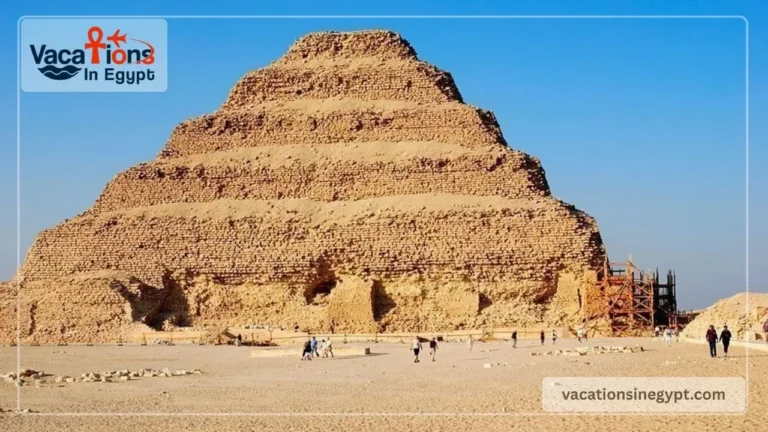
Dahshur is the southernmost area of the Memphis necropolis, with Saqqara being its most important part. The area contains five pyramids, two of which belong to King Sneferu of the 4th Dynasty. The oldest of these is called the Bent Pyramid because its upper angle changes, making it less steep.
The other pyramid is the so-called Red Pyramid, second only to the Great Pyramid of Giza (Khufu). The other pyramids in Dahshur date back to the Middle Kingdom and belong to Amenemhat II, Senusret III, and Amenemhat III. The tomb of Amenemhat II is the only one with a stone core, while the tombs of Amenemhat III and Senusret III each have mud-brick cores.
Amenemhat III also has a pyramid at Hawara, which is believed to have been his actual tomb, while the Dahshur pyramid was merely a monument (or shrine). Near these pyramids are the tombs of various princesses from the 12th Dynasty, where valuable gold jewelry has been found.
Saqqara is the modern name for the Memphis necropolis, located 16 kilometers south of Giza. The name Saqqara is possibly derived from the name of the funerary god Sokar. Saqqara contains tombs from all periods of Egyptian history, from the First Dynasty to the end of the Pharaonic era, as well as from the Coptic period.
In addition to a number of royal mastabas and pyramids, and the tombs of officials from the Old Kingdom, there are also the tombs of important people from later centuries, including the period when Thebes was the religious center of Egypt. However, Memphis was the seat of government for most of ancient Egyptian history, and this entailed a vast administrative apparatus.
Excavations at Dahshur have revealed the remains of seven pyramids, as well as extensive tomb complexes built for queens and nobility from Memphis up until the 13th Dynasty in the Middle Kingdom.
Dahshur Pyramids | the bent Pyramid | the red Pyramid The area is considered as royal necropolis for the Egyptian royal family, and consists mainly of two pyramids; the bent pyramid and the red pyramid.
Sneferu.
Two of its five extant pyramids date from the 4th dynasty (c. 2575–c. 2465 bce) and were built by King Snefru (reigned 2575–51).
The Bent Pyramid's unique silhouette is the result of an ancient architectural "pivot." The builders realized that the 54-degree slope was too steep and causing structural stress. To prevent a collapse, they adjusted the angle to 43 degrees for the top section, giving it its famous "bent" appearance.
Build your own private tour to Egypt — one detail at a time.