


 Alexandria Day Tours
 El Alamein Day Tour from Alexandria
from$75.00
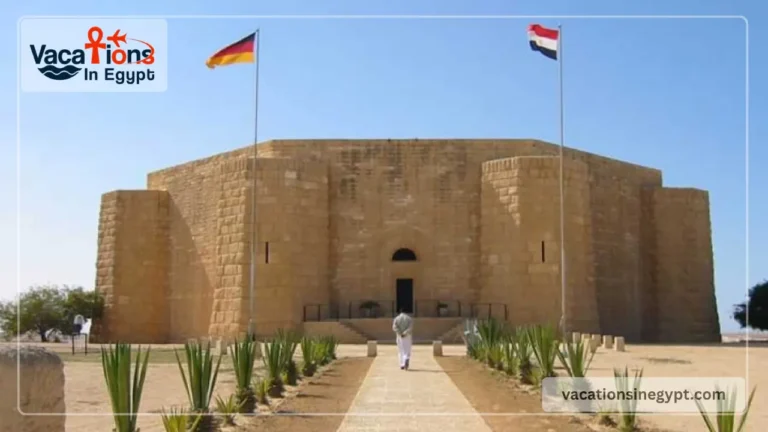
Alexandria Day Tours Italian Cemetery at Al Alameinis shrine stands at km 120 of the Alexandria-Marsa Matruh coastal road on a large area of hilly terrain. The Arabic toponym ‘Tel El Alamein’ means ‘the hill of twin peaks’.
All around stretches the vast desert plain on which the great battles of El Alamein took place. The memorial (designed by Paolo Caccia Dominioni, former Officer of the Alpine Engineer Corps and in North Africa Commander of the XXXI Battalion of the Engineer Corps) consists of three distinct building blocks: the memorial proper, the complex of buildings along the coastal road, the Italian
Also, The Shrine consists of an octagonal tower, slightly tapering upwards, which widens at the base into a large pavilion. Inside are the remains of the fallen soldiers. About 500 metres north-west of the memorial, on a small hill, stands the Italian base of QUOTA 33. Nearby are the remains of a tank cemetery, looted by Bedouins. At QUOTA 33, where the 52nd 152/37 Cannon Group had sacrificed itself (10 July 1942), the Italian base was built in 1948, from where 355 desert reconnaissance missions for the recovery of the Fallen were carried out, covering over 400,000 kilometres.
By the Reduci of the 31st BATTAGLIONE GUASTATORI D’AFRICA (on the labarum: one silver and one bronze medal for V.M.) to commemorate the fighting in Marmarica, Tobruk, Alamein and Tunisia (1941-1943) and the succession of the mission (Alamein 1948-1961) under the orders of the General War Memorial Commission. More than 5,200 Italian corpses from the Desert rest in the Shrine. The mission also participated in the recovery of some 6,000 German and Allied Corpses, and created the architectural works of the Italian Necropolises of Alamein and Tripoli.
– the cemetery of the Libyan Ascari, where the remains of 232 fallen soldiers rest, with an adjoining mosque
– the entrance portico with the Court of Honour
– the service complex with a small museum of war relics and a video projection room. The collection of the corpses of the Fallen, begun in 1943 by the British authorities (with labour made up of Italian and German prisoners), was completed in the years from 1949 to 1960 by a Delegation of the General Commission for the Honouring of the Fallen of War, led by Col. Paolo Caccia Dominioni who, with great self-sacrifice, dedicated himself to the pitiful work.
Also,The search and exhumation of the corpses, scattered over the vast battlefield, was particularly arduous and complex due to the extensive minefields that were still in place and which, in the ten years of the search, caused the death of seven native collaborators.
in fact, In 1955, the construction of the Quota 33 base was completed. The base is also a monument to the LII 152/37 gun group, in memory of the valour and sacrifice of the artillerymen who sacrificed themselves on the quota without yielding to the overwhelming power of the Australian attack.
“Here a voice rises mightily and admonishes never to despair in the destiny of Italy”. In the same year, the construction of the cemetery for Libyan ascars was also completed, according to strict Muslim burial rules.
Unlike the traditional headstone layouts of the Commonwealth graves, the Italian Memorial is a towering, white marble structure designed by Paolo Caccia Dominioni. It houses the remains of over 4,600 soldiers within a central octagonal tower, offering a deeply atmospheric and monumental experience.
Generally, access to the memorial is free for visitors, though it is always recommended to check local regulations or coordinate with a tour guide, as opening hours can occasionally shift due to maintenance or local holidays.
The memorial is located approximately 110 kilometers (about 68 miles) west of Alexandria. The drive typically takes around 1.5 to 2 hours via the Alexandria-Marsa Matrouh Road, making it a feasible day trip.
Yes. The interior of the Sacrario contains a series of niches where the remains are interred, many of which are marked with the names and ranks of the deceased. There is also a dedicated section for "Ignoto" (Unknown) soldiers.
The best time to visit is between October and April. During these months, the desert temperatures are much milder. If you visit in October, you may also witness the annual official commemorations held by various nations to mark the anniversary of the Battle of El Alamein.
Build your own private tour to Egypt — one detail at a time.