


 Nile Cruise Tour
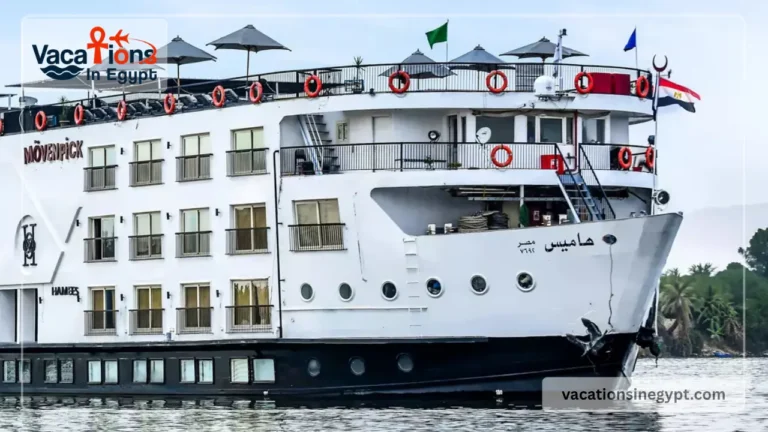
 Movenpick MS Hamees 5 Days
from$1,200.00
Nile Cruise Tour  Private & Historical tour in Egypt
  Nile Cruise Tour
 Ramses II of the New Kingdom, who ruled Egypt for some 67 years during the 19th Dynasty, built this mortuary temple to affirm his eternal greatness and proclaim his glory. The vast complex, which took more than 20 years to build, now lies almost entirely in ruins.
The Ramesseum originally consisted of a central temple flanked by two small shrines dedicated to his mother, Tuya—who was the wife of Seti I—and his beloved wife, Queen Nefertari, as well as a royal palace and several storerooms.
Dedicated to the god Amun, it housed the colossal statue of Ramses II, nearly 20 meters tall and weighing about 1,000 tons. Of the enormous fallen statue, only a few scattered fragments remain today.
Its structure also inspired the Temple of Medinet Habu, later built by Ramses III. To better understand the architecture of the Ramesseum, it is recommended to first visit the Temple of Medinet Habu, where visitors see the building as it was originally designed, with a front entrance from the first pylon, whereas at the Ramesseum the entrance is on the side, through the second courtyard.
The Ramesseum temple contains a series of inscriptions that recount the nature of life during this period of the Pharaonic state, as the images and inscriptions decorating the temple walls narrate the events of the famous Battle of Kadesh, in which King Ramses II defeated the Hittites, and how he planned the war.
Our tour of notable sites does not end here; next is the tomb of Nefertari. The tomb was discovered in 1904, and after some time, archaeologists discovered that the tomb’s paintings had been damaged, which is why salt deposits formed on the panels. This was caused by water seeping between the walls and the growth of bacteria. The humidity in the air is generated by visitors’ breath.
You’ll visit a special place called the Mortuary Temple of Merneptah, where you can feel and experience the wonder of ancient Egypt.
The Ramesseum was built as a "Mortuary Temple" for Pharaoh Ramses II. Unlike a tomb, which was meant for burial, this temple was a place of worship where the king’s cult was maintained after his death, ensuring his memory and divinity lived on for eternity.
It is considered a masterpiece of the New Kingdom. It features the massive "fallen colossus"a statue that inspired Percy Bysshe Shelley’s famous poem Ozymandias. Architecturally, it is famous for its massive brick storehouses (granaries) which are still standing today, showing the temple’s role as an economic hub.
The complex is situated on the West Bank of the Nile in Luxor (ancient Thebes). It sits within the vast Theban Necropolis, positioned between the Temple of Amenhotep II and the Temple of Thutmose IV
Yes. While the statue is no longer standing, the colossal head and torso lie in the temple's first courtyard. It originally stood over 17 meters high and was carved from a single block of pink granite transported from Aswan.
While Karnak was a state temple dedicated to the god Amun-Ra and built over many centuries by many pharaohs, the Ramesseum was a personal project of Ramses II specifically for his own funerary cult and the god Amun. It is smaller and more focused than the sprawling Karnak complex.
Build your own private tour to Egypt — one detail at a time.