


 Private & Historical tour in Egypt
 Best Attractions Across Egypt
from$1,800.00
Private & Historical tour in Egypt  Private & Historical tour in Egypt
  Private & Historical tour in Egypt
  Private & Historical tour in Egypt
  Adventure Tour
  Private & Historical tour in Egypt
  Private & Historical tour in Egypt
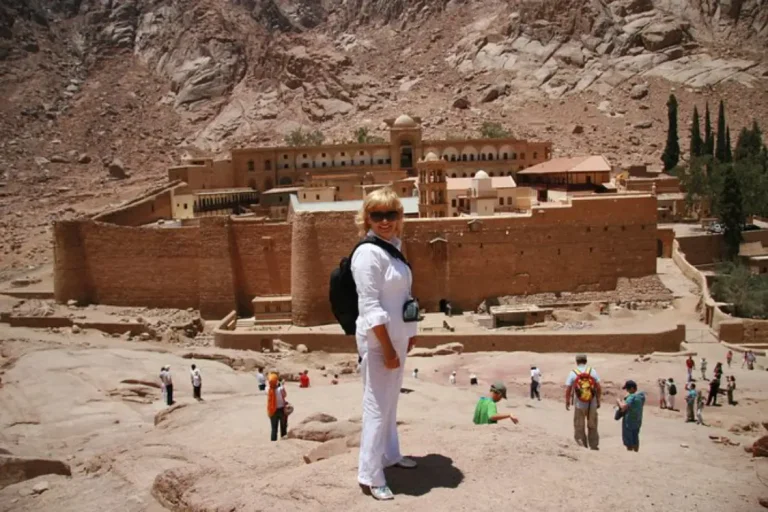
 Saint Catherine’s Monastery, a Greek Orthodox monastery located on Mount Sinai at more than 1,500 meters above sea level in a narrow valley north of Mount Musa in the Sinai Peninsula, is situated at the mouth of a canyon difficult to access at the foot of Mount Sinai.
It is built where tradition assumes that Moses saw the “bush that burned without being consumed”. It is one of the oldest monasteries still inhabited.
Often incorrectly called the Independent Greek Orthodox Church of Sinai, the monastic foundation is the smallest of the autonomous churches that together constitute the Eastern Orthodox Church.
The abbot of the monastery, who is also archbishop of Sinai, Paran and Raithu, is elected by the brotherhood and consecrated by the Greek Orthodox patriarch of Jerusalem. One of its first abbots was St. John Climacus.
The monastery was at first under the jurisdiction of the Patriarch of Jerusalem; its independence was recognized by Constantinople in 1575.
The number of monks is limited to 36; this figure includes those living in annexes (metochia) in other places, who today are mainly in Cairo and Suez Canal in Egypt. The laity of the Church of Sinai are some Arab Christians employed by the monastery and fishermen on the Red Sea coast at al-Ṭūr (Tor, formerly Raithu).
Muslim Bedouin Arabs living near the monastery have always acted as its guards and, in turn, have been supported by the monastery.
The monastery is of great importance because of its ancient and valuable library which holds the second largest collection of codices and manuscripts in the world, second only to the Vatican Library.
It contains some 3,500 volumes written in Greek, Coptic, Arabic, Armenian, Hebrew, Georgian, Syriac and other languages. It is remarkable a copy of the Ashtiname of Mohammed, a document in which the Islamic prophet grants protection to the monastery.
The monastery was named after St. Catherine of Alexandria, who was an Egyptian martyr of early Christianity, who suffered persecution and ultimately died at the hands of the Romans, because of her religious beliefs. It is also known as the Monastery of the Transfiguration or the Monastery of the Burning Bush.
The Monastery of St. Catherine was one of the great religious places of pilgrimage for more than 10 centuries.
The Library of the Monastery:
It is a large library that gave the monastery a great importance, second only to that of the Vatican in the number of codices and ancient manuscripts, in it you can find writings in Greek, Arabic, Coptic, Syriac, other languages of the region and European languages.
St. Catherine Convent
In 1975, workers accidentally penetrated a wall and discovered behind it a treasure trove of some 3,000 additional manuscripts, including ancient biblical texts and other known but long-lost documents, along with a variety of artwork.
Among the finds were missing parts of the Codex Sinaiticus, 50 other incomplete and 10 nearly complete codices, among other Greek texts in uncial script that shed new light on the history of Greek writing.
Even more numerous documents were found in various Semitic, Afro-Asiatic (formerly Hamito-Semitic) and Indo-European languages, dating from the 6th century and earlier.
St. Catherine’s Monastery was designated a UNESCO World Heritage Site in 2002.
St. Catherine was martyred in the early fourth century AD, and the monastery bears her name because her body was discovered by her monks near Mount St. Catherine in the ninth century AD, where it was placed by angels after her martyrdom. The monastery includes multiple structures, the most important of which is the Church of the Transfiguration of Christ the Savior, which itself includes nine smaller churches.
St. Catherine's location is one of its most important assets, as it is located in the heart of South Sinai Governorate at the top of a plateau 1,600 meters above sea level, specifically between the highest mountains in Egypt, namely: Mount St. Catherine, Mount Moses, and Mount Safsafa
A mountain located in the South Sinai Governorate in Egypt; its height is 2285 meters above sea level. It was named after the Prophet Moses, who spoke to his Lord on this mountain and received the Ten Commandments according to Judaism, Christianity, and Islam.
The Tor Sinai Monastery or St. Catherine's Orthodox Monastery is located at the foot of Mount Horeb, mentioned in the Old Testament, where Moses received the Tablet of Commandments, a site that Muslims also revere and call Mount Moses
The main highlights include the Basilica of the Transfiguration, the site of the Burning Bush, and the Monastery Library, which holds the world’s second-largest collection of early codices and manuscripts after the Vatican.
Build your own private tour to Egypt — one detail at a time.