


 All inclusive
 All Inclusive 5 Days Egypt Itinerary From USA
from$2,500.00
All inclusive  Private & Historical tour in Egypt
  Family Vacation Packages
  Private & Historical tour in Egypt
  Adventure Tour
  Private & Historical tour in Egypt
  Private & Historical tour in Egypt
  Private & Historical tour in Egypt
  Private & Historical tour in Egypt
  Private & Historical tour in Egypt
 The Burning Bush that currently exists in St. Catherine’s Monastery in Sinai, Egypt, is the tree at which the Prophet Moses called his Lord, and this type of blackberry plant is not found anywhere else except in Sinai, and it is a strange tree that has no fruits and is green all year round, and attempts to replant it anywhere in the world have failed.
in the monastery has its origin inside the Holy Blackberry Church and its branches outside it, and no one enters this church without removing his slippers outside its door, following the example of God’s prophet Moses, peace be upon him, who answered the call of his Lord and removed his slippers.
and Mount Moses in Sinai represents a value for all religions from Judaism and Christianity as well as Islam, as the story of God’s Prophet Moses and the Children of Israel is mentioned in several suras in the Holy Quran, and God Almighty has honored Mount Al-Tur and made it in the status of Mecca and Jerusalem, as God said: “And the Tin and the Zaytoun and the Tower of Sinin and this safe land,” Surat Al-Tin verses 1-3.
The Holy Bramble Bush, currently located at St. Catherine’s Monastery, is the tree through which God spoke to Moses, because this species of bramble bush is found nowhere else in Sinai. It is a unique tree that bears no fruit and remains green throughout the year; attempts to propagate it elsewhere in the world have failed.
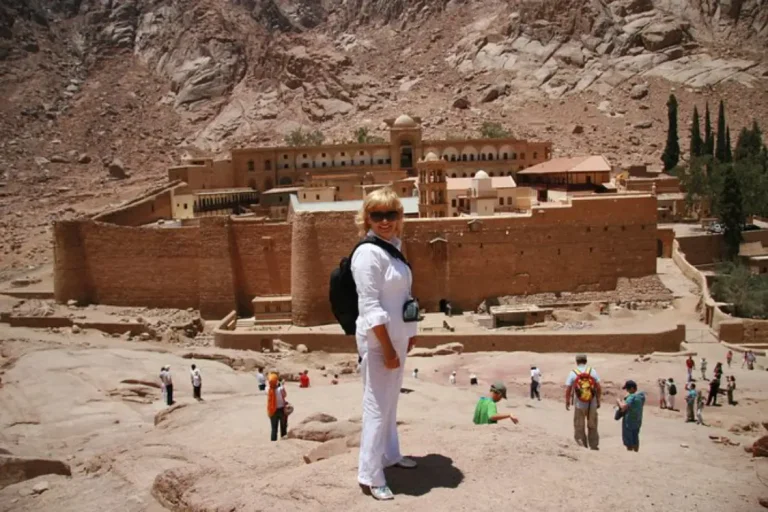
St. Catherine’s Monastery contains a church known as the Church of the Holy Bush, built by Empress Helena, mother of Emperor Constantine, in the 4th century AD near the Holy Bush. When Emperor Justinian built the Monastery of Mount Sinai in the 6th century AD, he incorporated it into the monastery’s main church, and the monastery was named St. Catherine’s Monastery in the 9th century AD, in reference to the famous story of Saint Catherine.
The floor of the Church of the Burning Bush is 70 cm lower than that of the Church of the Transfiguration; it measures 5 m in length and 3 m in width and contains a small circular altar set on marble columns above a marble slab marking the tree’s actual location. It is said that its roots still remain at this site.
The current fig tree in the monastery has its roots inside the church and its branches outside; no one enters this church without removing their shoes outside.
The Burning Bush which is currently located in St. Catherine's Monastery in Sinai, Egypt, is the tree that the Prophet Moses called his Lord, and this type of blackberry plant is not found anywhere else except in Sinai, and it is a strange tree that has no fruits and is green all year round, and attempts to replant it anywhere in the world have failed.
The site is located inside the walls of Saint Catherine’s Monastery at the base of Mount Sinai (Jebel Musa) in the Sinai Peninsula of Egypt. It is housed within a specific courtyard near the Chapel of the Burning Bush.
Yes, visitors can see the bush that tradition identifies as the "Burning Bush." It is a rare species of bramble (Rubus sanctus) that has been growing in the monastery courtyard for centuries. Monks have carefully preserved it, and it is the only one of its kind in the entire Sinai Peninsula.
The Chapel of the Burning Bush is considered the most sacred part of the monastery. Interestingly, the altar of this chapel is built directly over the spot where the roots of the bush are said to be. Out of respect for the biblical command, visitors are often asked to remove their shoes before entering the chapel.
No, visitors are strictly prohibited from touching or taking cuttings from the bush to ensure its preservation for future generations. However, the monastery is beautifully maintained, and the bush is clearly visible from the courtyard for photography and reflection.
The best time to visit is in the early morning, as the monastery's visiting hours for the public are usually limited (typically between 9:00 AM and 11:30 AM). Visiting during the spring or autumn months offers the most comfortable weather for exploring the monastery and the surrounding Sinai mountains.
Build your own private tour to Egypt — one detail at a time.