


 Private & Historical tour in Egypt
Tour to Wadi El Natroun
from$130.00
Private & Historical tour in Egypt
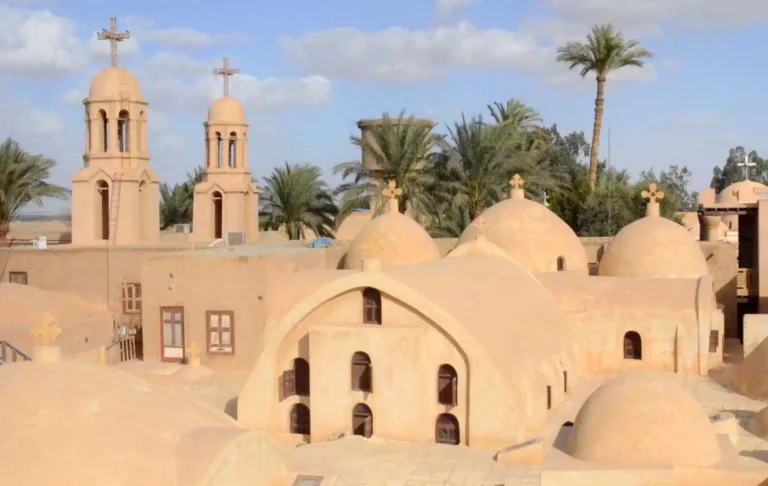
The Monastery of Baramus is one of the first monasteries in Wadi El-Natroun and is dedicated to the Virgin Mary The monastery receives a number of visitors and monks This monastery was built for Saint Macarius the Great to settle in so that he could devote himself to monastic life. It was certainly the first monastery built in the region.
Although the goal of its construction was monastic life, it was a tower to defend the Nitrian Desert, and fossils and structures were discovered.
The Monastery of El Baramos still retains much of its ancient character. It has five churches—the oldest church of the Virgin Mary. The second church is dedicated to Saint Theodore Amasia. The third is for Saint George, the fourth is for Saint John the Baptist, and the fifth is for the Archangel Michael. The monastery also contains a fort, a tower, two dining rooms and a guest house.
Description of the monastery: The monastery is a square surrounded by walls 2 meters wide and 10 to 11 meters high. The original entrance to the monastery is on the sea side and opens onto a covered entrance passageway; above it is a room used to feed the Bedouins without opening the monastery gate. Another gate was opened on the eastern side when plans were first made to establish a farm outside the monastery.
The main buildings within the monastery walls are the churches, the refectory, the fortress, and the cell blocks. Most of the cell block buildings are modern, except for the cell block on the southern side of the ancient church, which is old and has a vaulted ceiling.
1. The Ancient Church of the Virgin Mary Built around 350 AD during the time of St. Abu Makar, it covers an area of 1,200 square meters and is divided into three naves.
The first: It contains the central sanctuary, beneath which lie the bodies of Saints Maximus and Domadius, and two side sanctuaries. The iconostasis features a collection of ancient icons. There is also a niche containing the bodies of St. Moses the Black and his teacher, St. Isidore.
The second: It contains the lakan, a marble basin, and the Column of Arsenius, beside which the saint used to stand in silent contemplation and seclusion during the Divine Liturgy.
On the apse side: We find the table, and to its left is a Y-shaped stone shelf on which the Book of the Garden was placed for him to read while eating.
2. Prince Tadros Church This is a small church located to the north of the second choir.
3. St. George the Martyr Church It is located at the end of the third choir, and next to it is the baptismal font in its liturgical position (in the northwest).
4. Church of St. John the Baptist Built on the ruins of the Church of Anba Apollos and Anba Abib in 1879 AD during the reign of Pope Cyril V, it is also divided into three naves. The iconostasis is Byzantine, as is the icon stand. The church was renovated in 1981 during the reign of Pope Shenouda III under the leadership of His Eminence Anba Arsanios, abbot of the monastery. Entrance to the Church of St. John the Baptist.
5. Church of the Archangel Michael It is located atop the old fortress, where the monks would seek the intercession of the Archangel Michael during Berber raids.
As is customary, it consists of a ground floor, a first floor, and a second floor. The layout features a central corridor flanked by rooms, and atop the second floor is the Church of the Archangel Michael, as is customary. Modern buildings for the monks, the retreat, guests, the church, and the farms have been constructed around the monastery.
Built by the late Anba Thomas, former Bishop of Minya, at his own expense; it appears he intended to refer to Saints Maximus and Domadius.
Saints Maximus and Domadius of Rome, the mighty Saint Anba Musa the Black, Saint Arsenius, teacher of the kings’ children, and Saints Anba Apollos and Anba Abib.
The monastery was established around 350 AD by Saint Macarius the Great. It is considered the oldest of the four current monasteries of Wadi El Natrun and is famously known as the "Monastery of the Romans."
The monastery is dedicated to Saints Maximus and Domadius, sons of a Roman Emperor. Other prominent saints include Saint Moses the Black, Saint Arsenius, and the martyrs Anba Apollos and Anba Abib.
Visitors can explore five historic churches, most notably the ancient Church of the Virgin Mary. The complex also features a medieval fortress, historical cell blocks with vaulted ceilings, and a refectory where monks once shared meals.
The fortress is a key architectural feature consisting of three floors. It contains the Church of the Archangel Michael on the top level, which historically served as a place of refuge and prayer for monks during raids.
The name "Baramous" is derived from the Coptic "Pa-Romeos," which translates to "That of the Romans." This honors Saints Maximus and Domadius, the Roman princes who sought a life of asceticism in the Egyptian desert.
Build your own private tour to Egypt — one detail at a time.