Aga Khan Mausoleum in Aswan: The Timeless Love Story Behind Egypt’s Most Romantic Shrine
Few monuments in Egypt carry as much emotional weight as the Aga Khan Mausoleum in Aswan. Perched on a golden desert hill overlooking the Nile, this elegant granite shrine is not only a testament to one of Islam’s most influential leaders — it is also one of history’s most enduring love stories. Every day for decades, a single red rose was placed on the tomb. This is the story behind it.

Who Was the Aga Khan III?
Muhammad Shah, known as the Aga Khan III, was born in 1877 and became one of the most significant figures in 20th-century Islamic history. He served as the Imam of the Ismaili Muslim community and was one of the founding members and first president of the All India Muslim League — an organization established to protect the political and civil rights of Muslims in India.
A visionary leader, the Aga Khan III placed education above politics, believing that knowledge was the true foundation of progress. Even after stepping back from formal political life, he continued to advocate for Muslim independence in India and left a lasting mark on the development of modern Islamic civil society.
He was also, by the time of his death, one of the wealthiest men in the world.
The Love Story: A Red Rose Every Day
The Aga Khan III married four times throughout his life. His fourth and final wife was Yvonne Blanche Labrousse, a Frenchwoman who first came into his life as his secretary. Over time, their professional relationship deepened into something far more profound, and the two eventually married.
Their bond became legendary for one small, deeply devoted gesture: every single day, Yvonne — known as La Begum — would place a fresh red rose on her husband’s lapel.
When the Aga Khan III passed away on 11 July 1957, La Begum did not stop. She simply moved the rose from his lapel to his tomb, visiting the mausoleum in Aswan to lay the flower herself. On the days she could not come, the mausoleum’s gardener was entrusted with placing the rose in her absence.
She kept this ritual for more than four decades.
When La Begum passed away in 2000, she was buried beside her husband in the same mausoleum — together again at last. Today, a single red rose still rests on the tomb in honor of their story.
Why Did the Aga Khan Choose Aswan?
The Aga Khan III’s connection to Aswan began not with history or religion, but with illness. In the later years of his life, he suffered from severe bone disease and rheumatism that left him reliant on a wheelchair — a condition that had defeated doctors across the world.
A close friend suggested he travel to Aswan in winter, drawn by the city’s famously dry, warm climate. He arrived and took up residence at a local hotel. There, a revered local sheikh offered an unconventional remedy: bury the lower half of the body in Aswan’s warm desert sand for three hours a day, for one week.
The Aga Khan followed the advice. Remarkably, he recovered.
From that moment, he returned to Aswan every winter without exception. He grew to love the city deeply — its light, its stillness, its sweeping views of the Nile — and made a personal decision that when he died, Aswan would be his final resting place.
About the Aga Khan Mausoleum
Architecture and Design
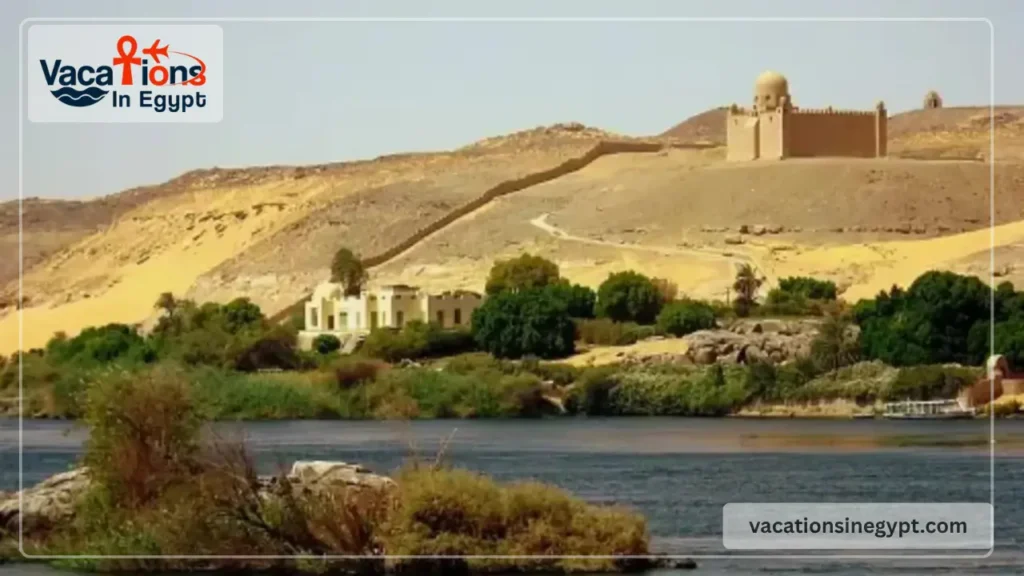
The mausoleum was commissioned by the Aga Khan himself and took 16 months to build. Designed by an Egyptian architect, it is constructed primarily from pink granite — the same stone used by the ancient Egyptians for their greatest monuments — while the interior tomb is crafted from white Carrara marble.
The structure draws clear inspiration from Fatimid Islamic architecture, the style that defined Cairo’s great medieval mosques and mausoleums. Its clean lines, arched windows, and domed silhouette sit in striking contrast against the bare desert hill on which it stands, creating a visual composition of rare elegance.
Location
The mausoleum is situated on the west bank of the Nile in Aswan, approximately 4 kilometers from Aswan’s main train station. It stands near the historic Monastery of Saint Simeon and commands panoramic views of the river and the city below.
Its elevated position means that virtually every Nile cruise ship passing through Aswan can be seen from the mausoleum — and the mausoleum seen from the water.
Visitor note: In 1997, La Begum made the decision to close the mausoleum’s interior to the general public in order to preserve the sanctity of the space. The exterior, gardens, and views remain accessible to visitors.
What to See and Do Near the Aga Khan Mausoleum
A visit to the mausoleum pairs naturally with several other extraordinary sites in the immediate area.
Philae Temple
One of Egypt’s most beautifully situated ancient temples, the Temple of Philae is dedicated to the goddess Isis and sits on an island in the Nile just a short distance from the mausoleum. It is best reached by motorboat and is especially magical at sunset.
Nubian Village and Market
The Nubian community around Aswan is one of the most culturally vibrant in all of Egypt. After visiting the mausoleum, explore the Nubian market for handmade crafts, spices, colorful textiles, and unique souvenirs you will not find anywhere else in the country.
Nile Felucca Ride
One of the most relaxing ways to see the mausoleum from a different angle is from the water. A traditional felucca sailboat glides silently past the hill on which the shrine stands, offering a perspective that is both peaceful and deeply photogenic.
Nubian Cuisine
Round off your visit with a meal at one of Aswan’s Nubian restaurants. The local cuisine — featuring slow-cooked stews, grilled fish, and aromatic spiced dishes — is a distinct and delicious culinary tradition, best enjoyed riverside with a glass of mint tea.