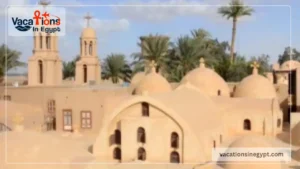

Wadi El Natrun
What Is Wadi El Natrun?

Tucked between Cairo and Alexandria in the heart of the Western Desert, Wadi El Natrun is one of Egypt’s most extraordinary and undervisited destinations. This ancient oasis is a rare convergence of natural beauty, spiritual heritage, and archaeological significance — home to shimmering salt lakes, abundant wildlife, prehistoric fossils, and four of the oldest and most revered Christian monasteries in the world.
Whether you are drawn by faith, history, nature, or simply the desire to experience a side of Egypt that few tourists discover, Wadi El Natrun promises a deeply memorable journey.
The History of Wadi El Natrun

The story of Wadi El Natrun stretches back to at least the fourth century AD, when it became a refuge for early Coptic Christians fleeing persecution. Monks and hermits sought shelter in the valley’s caves, drawn by its isolation and the spiritual solitude of the desert.
As religious freedoms were gradually restored, Wadi El Natrun was formally established as a center of Coptic Christian life. Monasteries were built, ancient churches were restored, and the valley transformed from a place of hiding into a thriving hub of faith and scholarship. Today, all four of its historic monasteries remain active religious communities that continue to welcome pilgrims and visitors from around the world.
Long before Christianity, however, the valley held great significance for ancient Egypt. Its abundant deposits of natron — a naturally occurring salt compound — were essential to the pharaonic mummification process, making Wadi El Natrun a strategically vital resource for thousands of years.
Geography, Location & Climate
Wadi El Natrun is situated in the desert northwest of Cairo, roughly midway along the Cairo–Alexandria desert road. The valley sits below sea level and is fed primarily by rainwater and underground springs, giving rise to its remarkable series of lakes.
The climate follows a classic desert pattern — hot and dry in summer, mild and pleasant in winter — making the cooler months between October and April the ideal time to visit. The serene desert landscape and crisp winter air make Wadi El Natrun a genuinely restorative escape from the bustle of Cairo.
The Four Monasteries of Wadi El Natrun
Wadi El Natrun is inseparably linked to the origins of Christian monasticism. Its four monasteries are among the oldest continuously inhabited religious communities on Earth and represent an extraordinary living tradition of Coptic faith, art, and architecture.
1. The Monastery of Al-Baramus
The oldest monastery in Wadi El Natrun, Al-Baramus was founded by Saint Macarius the Great and is dedicated to the Virgin Mary. Despite its origins as a place of quiet monastic retreat, the monastery also served as a defensive stronghold for the Nitrian Desert and has witnessed centuries of history within its ancient walls.
Today it contains five churches — the oldest dedicated to the Virgin Mary, with additional churches honoring Saint Theodore Amasia, Saint George, Saint John the Baptist, and the Archangel Michael. The complex also includes a historic fort, a tower, two dining halls, and a guest house, much of it retaining its ancient character.
2. The Monastery of Anba Bishoy (Deir al-Anba Bishoy)
One of the most celebrated monasteries in Coptic Christianity, the Monastery of Anba Bishoy is dedicated to one of Egypt’s most venerated saints — Bishop Bishoy, whose deep spiritual legacy continues to draw pilgrims to this day. The monastery is particularly associated with His Holiness Pope Shenouda III, who championed major restoration and expansion works here.
The complex features the main Church of Anba Bishoy, a historic deep well, a palace accessed via a bridge, and numerous buildings constructed as part of modern expansions beyond the original monastery walls.
3. The Monastery of the Syrians (Deir al-Surian)
Located approximately 500 meters northwest of the Monastery of Anba Bishoy, the Monastery of the Syrians was originally dedicated to the Virgin Mary before being taken over by Syrian monks — the origin of its distinctive name. The monastery is a remarkable repository of Coptic heritage, containing the Church of the Holy Virgin, the Church of Saint Eunus, a historic tower, and a museum-library housing hundreds of rare ancient manuscripts, making it one of the most academically significant sites in the entire region.
4. The Monastery of Saint Macarius (Deir Abu Magar)
The southernmost of the four monasteries, the Monastery of Saint Macarius was founded by Saint Macarius the Great himself in the fourth century and holds a unique place in Coptic history as the traditional headquarters of the Coptic Church. It is considered the richest of the four monasteries in terms of historical and religious significance, and within its walls lie the remains of forty-nine martyrs killed by the Berbers — a solemn and deeply moving testament to the resilience of early Egyptian Christianity.
The Lakes of Wadi El Natrun

One of the most visually striking aspects of Wadi El Natrun is its lakes. The valley contains approximately 12 lakes, formed by a combination of rainfall and underground water sources. These lakes are remarkable for their vivid coloring — ranging from deep blue to striking red — a result of the high mineral and salt concentrations in the water.
The lakes and surrounding wetlands form a protected ecosystem that supports a rich array of birdlife and desert wildlife, making Wadi El Natrun a rewarding destination for nature lovers and birdwatchers alongside its appeal to history and religious heritage travelers.
The Cultural Significance of Wadi El Natrun
Few places in Egypt carry the same breadth of cultural importance as Wadi El Natrun. Its legacy spans multiple civilizations and belief systems:
In Pharaonic Egypt, the valley’s natron salt deposits — from which it takes its name — were indispensable to the mummification process. Natron was also used in glassmaking and a range of industrial applications, cementing the valley’s role as an economic resource of national importance.
In early Christianity, Wadi El Natrun is recognized as one of the birthplaces of Christian monasticism, a place where the traditions of communal religious life were first established and refined.
In natural history, the valley’s fossil-rich geology has yielded significant finds, attracting researchers and paleontology enthusiasts from around the world.
Camping in Wadi El Natrun
For those seeking a more immersive experience, Wadi El Natrun is one of Egypt’s finest camping destinations. Spending a night beneath the desert sky, surrounded by the stillness of the oasis and within reach of its ancient monasteries, offers a profound sense of connection to both nature and history. Desert camping trips to Wadi El Natrun can be arranged through specialist tour operators.
Key Facts About Wadi El Natrun
- The name “Natrun” derives from the abundant natron salt deposits found throughout the valley
- Natron from this valley was used by the ancient Egyptians in the mummification of pharaohs and nobles
- The valley is home to four of the oldest active Christian monasteries in the world
- Approximately 12 lakes dot the landscape, many displaying vivid blue and red coloring
- The area contains significant deposits of animal fossils, drawing paleontologists and researchers
- Wadi El Natrun is a protected natural area due to its diverse and fragile ecosystem
- The valley played a role in Egypt’s early glass industry and railway construction
Plan Your Visit to Wadi El Natrun
Wadi El Natrun is best reached by private car along the Cairo–Alexandria desert road, making it a comfortable day trip from Cairo or a scenic stop en route to Alexandria. The monasteries are generally open to visitors, though modest dress is required and certain areas may be reserved for monks and pilgrims.
For the richest experience, combine your visit to the monasteries with time spent exploring the lakes and the surrounding desert landscape. Whether you come seeking spiritual reflection, historical discovery, or natural wonder, Wadi El Natrun is a destination that leaves every visitor with a lasting impression.