

Scarab Beetle In Ancient Egypt
Scarab Beetle In Ancient Egypt, is one of the most famous amulets of Ancient Egypt, but the origin of its symbolic power is, to say the least, curious.
Why would the Egyptians associate such an unmajestic animal with the god of creation? Forget mysticism, the answer is much more earthly: the ball of excrement that the dung beetle kneads seemed very similar to the work that the god Ra would do every sunrise with the Sun.
In addition, it was believed that this animal reproduced itself without the need for a partner, which was all the more reason to bring it closer to the great god.
Egyptian Beetle
Because the small Scarab Beetle In Ancient Egypt seemed to emerge spontaneously from these tunnels, the Egyptians worshipped them under the name Jepri, “he who became” or “he who came to be”, and related them, from the earliest times to the creator god Atum. The lightning-like protuberances on the head of the dung beetle, and its habit of pushing a ball of excrement before it.
also suggested solar symbolism; and the god Jepri was believed to roll, in the same way, the solar disk across the sky.
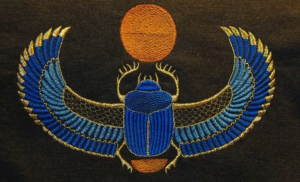
Egyptian Scarab Beetle
The people of Egypt referred to the sacred scarab as Ra Men Kepher, which means Ra, creator of the Universe. It was used as a great amulet that protected from disease and death and was usually made of lapis lazuli, azurite and sugilite and was set in rings, brooches and bracelets, as is the case of the bracelet found in the tomb of Tut-Anj-Amon, with a large scarab, dark blue.
Ancient Egyptian scarab beetle
In Ancient Egypt the scarab was deified, being linked to the god Jepri, who is represented with a human body and a beetle’s head and represents the constant change of existence. The Egyptians were convinced that this amulet symbolized protection both in life and in death since the one who wore it in his life acquired strength and protection against all evil and in death would have the possibility of resurrection and eternal life.
facts about Egyptian scarab beetle
- They began to use a ritual in the mummies and to use the scarab-heart, as an amulet, so that in the ceremony of the weighing of the heart, it would prevent it from going against its owner, engraving an inscription, taken from the Book of the Dead, these scarabs could be made of granite, basalt, statite, etc.
- The Egyptians thought that the scarab, covered with rituals and prayers, would protect the dead from the judgment of Osiris since memories were stored in the heart and the worse the person had been, the heavier the heart would be and it would not pass the test.
- The judgment consisted of placing on a scale, on one side the heart of the deceased and on the other, a feather. The feather symbolized the goddess Maat, goddess of truth and justice, both sides of the scale should be balanced to favor the deceased, since the better person he had been, the less his heart would weigh.
- The scarab can also be found sculpted or painted in other places, such as reliefs in tombs, (Sethy I) or in papyri, hieroglyphs or stelae. In the tomb of Queen Nefertari, in the Valley of the Queens, we find a representation of the god Jepri.
Egyptian Scarab Beetle
The meanings of this small insect do not end here. The Egyptians have bequeathed us a multitude of archaeological remains and among the most common are the scarabs. They were black or blue amulets, depending on the material with which they were carved, which had the power to protect their owner. Their use spread throughout all sectors of society. They inscribed their names or symbols on the back of the scarab to capture this protection to their person.
Scarab beetle jewelry Ancient Egypt
At another level were the commemorative scarabs that, although they had practically the same meaning, were larger pieces, only available to the nobility and the court of the pharaoh. Instead of the name of the owner, they depicted complete scenes of certain relevance, such as the hunting of a lion or the arrival of a foreign princess.
Finally
We have the heart scarabs. They were pieces placed on the chest of the mummies, on the position of the heart, to protect this organ of vital importance to resurrect in the afterlife.
The deceased had to pass the Judgment of Osiris, in which his heart had to weigh less than the feather of Maat, a symbol of Truth and Justice.
Times change and today’s beliefs have little to do with those of more than two thousand years ago. But if you also happen to have one of these amulets at home, you know that they are more than just lucky beetles.