


 Private & Historical tour in Egypt Private & Historical tour in Egypt
  Cheap Egypt Tours & Budget Packages
  Luxury Tour
  Nile Cruise Tour
  Christmas Tour
  Adventure Tour
  Adventure Tour
  Private & Historical tour in Egypt
  Christmas Tour
  Private & Historical tour in Egypt
  Family Vacation Packages
  Private & Historical tour in Egypt
  Food Tour
  Nile Cruise Tour
  Private & Historical tour in Egypt
  Private & Historical tour in Egypt
  Private & Historical tour in Egypt
  Private & Historical tour in Egypt
  Private & Historical tour in Egypt
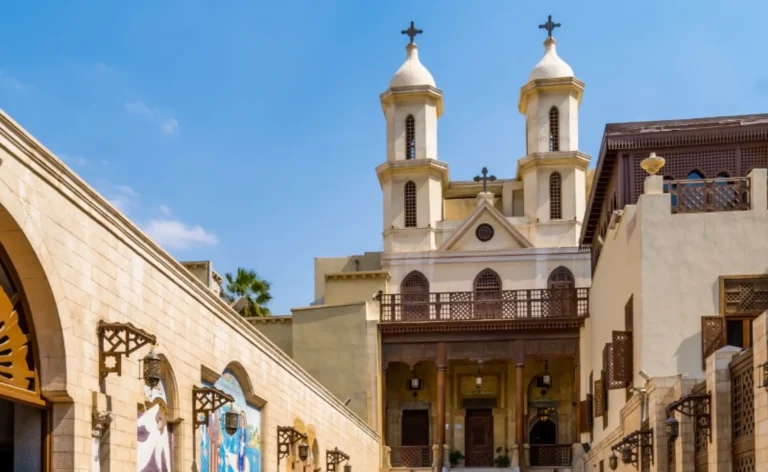
 The Saint Sergius and Bacchus Church is the most important part of This Coptic church was built in Old Cairo sometime in the fourth century CE. According to legend, this site was chosen because it is located over a cave where Jesus, Mary and Joseph rested for some time at the end of their flight from King Herod’s persecution in Palestine as refugees to Egypt.
The Saint Sergius and Bacchus Church has burned and been restored several times over the centuries, suffering its first fire in 750 and was last restored in 2000.
The Saint Sergius and Bacchus Church is named in honor of two saints revered in the earliest Christian denominations. Sergius and Bacchus were apparently high-ranking officers of the Roman army, who were discovered to be Christians before being tortured and killed. Although there is much doubt about the legend, many churches throughout the Mediterranean region bear their names.
Factes about Saint Sergius and Bacchus Church
The Church of St. Sergius and Bacchus, two early Syrian Christian martyrs, is located in the Old Cairo district (Masr El Qadima). The church is considered the oldest church in Egypt, dating back to the 4th century. It is believed that the Holy Family stayed in the cave behind the sanctuary before leaving Egypt on their way back to Palestine. The church was badly affected by the fires that burned the city of Fustat during the Crusades, so it was later rebuilt. Many patriarchs of Alexandria were elected here. Of special interest in the church is the Basilican style of architecture with a wooden iconostasis, altar, three shrines, and the Crypt of the Virgin behind.
Sergius and Bacchus were members of the Roman nobility, and despite their young age, they held important military positions during the reign of Emperor Maximian. Once, as was the custom of emperors of that time, the emperor called for sacrifices to be offered to the pagan gods as an expression of loyalty to the sovereign. All the nobles and army commanders attended, except for Sergius and Bacchus. When the emperor inquired about this, he learned that they were Christians. Their response was: “We serve only in your earthly army, Your Majesty. But to deny the one true God whom we worship and to offer worship to lifeless gods—neither iron nor fire can compel us to do so….” The emperor was furious, and immediately ordered that their robes, rings, and all signs of rank be stripped from them and that they be dressed in women’s clothing. Then they placed chains around their necks and led them through the city center to be mocked and ridiculed. Finally, the emperor ordered them to be exiled to a city on the Euphrates River called Pals, which was the seat of the governor of the East, Antiochus, as a humiliation for them, since this Antiochus had served under Sergius and was famous for his ferocity and hostility toward Christians.
Antiochus tried to show off in front of his former superior, but the greatness of Sergius and Bacchus and their steadfastness made him feel weak, helpless, and small, as if he were a dwarf. He then turned into a ravenous beast, throwing Sergius into prison and handing Bacchus over to the torturers, who beat him mercilessly until his spirit departed. As for Sergius, he waited a few days for the governor, who then took him to a Syrian village known as Al-Rasafa, near Palmyra, about two hundred kilometers east of Aleppo, where he ordered his head to be cut off. The place where Sergius was buried became a shrine to which people flocked from all directions, so much so that it grew into a city and came to be known as Sergius: Sergius Polis, meaning the City of Sergius. The veneration of Sergius and Bacchus also spread to many places in the Levant. It is said that the first church built in his honor was in Bosra, Horan, in 512 AD.
Emperor Justinian also built two great churches named after Saint Sergius (Sarkis), one in Constantinople and the other in Acre, Palestine (6th century). There are many churches and monasteries in Lebanon and Syria named after Sergius or Sergius and Bacchus together. Scholars believe that the veneration of these two saints in our country stems, in particular, from the Horanite background of many Christian families. It is worth noting that Saints Sergius and Bacchus were among the most prominent intercessory saints among the Ghassanids. Among these sites is a monastery named after Saint (Mar) Sarkis (Sergius) near the current Monastery of Our Lady of Kaftoun, which belongs to the Orthodox Diocese of Jbeil, Batroun, and their dependencies (Mount Lebanon). Scholars believe this dates back to between the fifth and seventh centuries.
Note: Today is a feast celebrated in both the East and the West
Troparion of the Holy Martyrs Sergius and Bacchus in the First Tone O martyrs who shine in the struggle, you have appeared as defenders of the Holy Trinity, O divine and victorious Sergius, and O brave and valiant Bachos. Therefore, since you have been glorified openly, you fight for those who cry out: Glory to Him who strengthened you, glory to Him who crowned you, glory to Him who worked through you to bring healing to all.
Hymn in the Third Tone Let us gather and crown with noble praises the brave martyrs and brothers in faith, Sergius, armed with the power of the Trinity, and Bacchus, steadfast in his sufferings, both praising Christ, the author of the struggle and the creator of all.
Abu Serga, or Saint Sergius and Bacchus Church, is traditionally believed to be built over the cave where the Holy Family (Mary, Joseph, and the infant Jesus) rested at the end of their journey into Egypt. It is also one of the oldest churches in the country, dating back to the 4th or 5th century.
Yes, the church features a 10-meter-deep crypt directly beneath the sanctuary. While the crypt is occasionally closed when the Nile’s water level rises and causes flooding, it is a primary site for pilgrims who come to pray and see where the Holy Family took shelter.
They were high-ranking Roman soldiers who were martyred in Syria during the 4th century for their Christian faith. The church was dedicated to them to honor their courage and devotion, which remains a central theme for visitors today.
Entry to the church is generally free of charge for all visitors. However, since it is an active place of worship, it is important to dress modestly (covering shoulders and knees) and remain quiet during prayer services.
Abu Serga is located in the heart of "Coptic Cairo," just a few minutes' walk from other major landmarks like the Hanging Church (Al-Muallaqa), the Ben Ezra Synagogue, and the Coptic Museum. It’s an ideal area for a full day of historical exploration.
Build your own private tour to Egypt — one detail at a time.