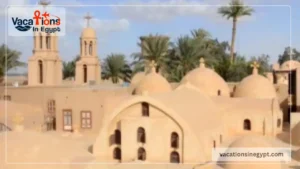
Catacombs of Kom El shoqafa
If you explore the subsoil of Alexandria, you will find it riddled with a vast complex of cisterns and history. However, the most significant discovery lies just south of Pompey’s Pillar: the Catacombs of Kom El Shoqafa.
Considering one of the Seven Wonders of the Middle Ages, this archaeological site is the largest known Roman burial site in Egypt. It offers a rare glimpse into a time when Egyptian, Greek, and Roman cultures merged into one.
What are the Catacombs of Kom El Shoqafa?
The Catacombs of Kom El Shoqafa (or the Catacombs of Alexandria) are a historical necropolis with origins dating back to the late first and early second century A.D. during the era of Roman domination.
While they share their name with the famous Christian catacombs of Rome due to design similarities, these tombs are unique to Egypt. They represent the last major construction of the ancient Egyptian religion before the spread of Christianity.
The Fascinating History and Discovery of the “Mound of Shards”
The name Kom El Shoqafa translates literally to “Mound of Shards” or “Hill of the Shards.” This name is derived from the massive piles of broken terracotta vases and pottery found by archaeologists in the area.
It is believed that ancient visitors brought food and wine to the tombs for funerary feasts. Due to superstition, they would break the plates and jars after eating rather than bringing them home, leaving thousands of shards behind.
The Discovery: The discovery of the site in 1900 (excavations began shortly after earlier finds in 1892) was famously accidental. A donkey hauling a cart on the surface suddenly disappeared into a pit that opened in the ground, revealing the main access shaft to the underground tunnels below.
Who Built the Catacombs of Kom El Shoqafa?
Archaeologists confirm that this vast complex was not originally intended for the public. It began as a private tomb for a single wealthy family. However, over the centuries, the site was expanded.
As the need for burial space grew, new chambers were hacked into the rock, and burial niches (loculi) were added in rows above one another. Eventually, it converted into a massive public cemetery accommodating over 300 mummies.
Architectural Layout: Exploring the Three Levels
The complex reaches a depth of over 30 meters (100 feet) into the solid rock and is divided into three distinct levels.
The Entrance and Level One
To enter, visitors descend a circular spiral staircase that wraps around a central well. This well was used to lower the bodies of the deceased using ropes, while the living walked down the stairs.
- The Rotunda: At the bottom lies a vestibule and a central round room (rotunda).
- The Triclinium: To the left is the banquet hall, where relatives and friends paid their last respects and shared a funeral meal.
Level Two: The Main Tomb
This is the fulcrum of the complex. Behind the rotunda, stairs lead down to the main burial chamber. Here, the “Hall of Caracalla” can be found—an ancient complex dedicated to Nemesis, the goddess of sport. This area became accessible only after grave robbers broke through the walls centuries ago.
Level Three: The Submerged Chambers
The lowest level of the Catacombs of Kom El Shoqafa is currently submerged in groundwater. While the water level dropped significantly after 1995 allowing access to the second level, the third level remains inaccessible to tourists today.
A Fusion of Art: Egyptian, Greek, and Roman Styles
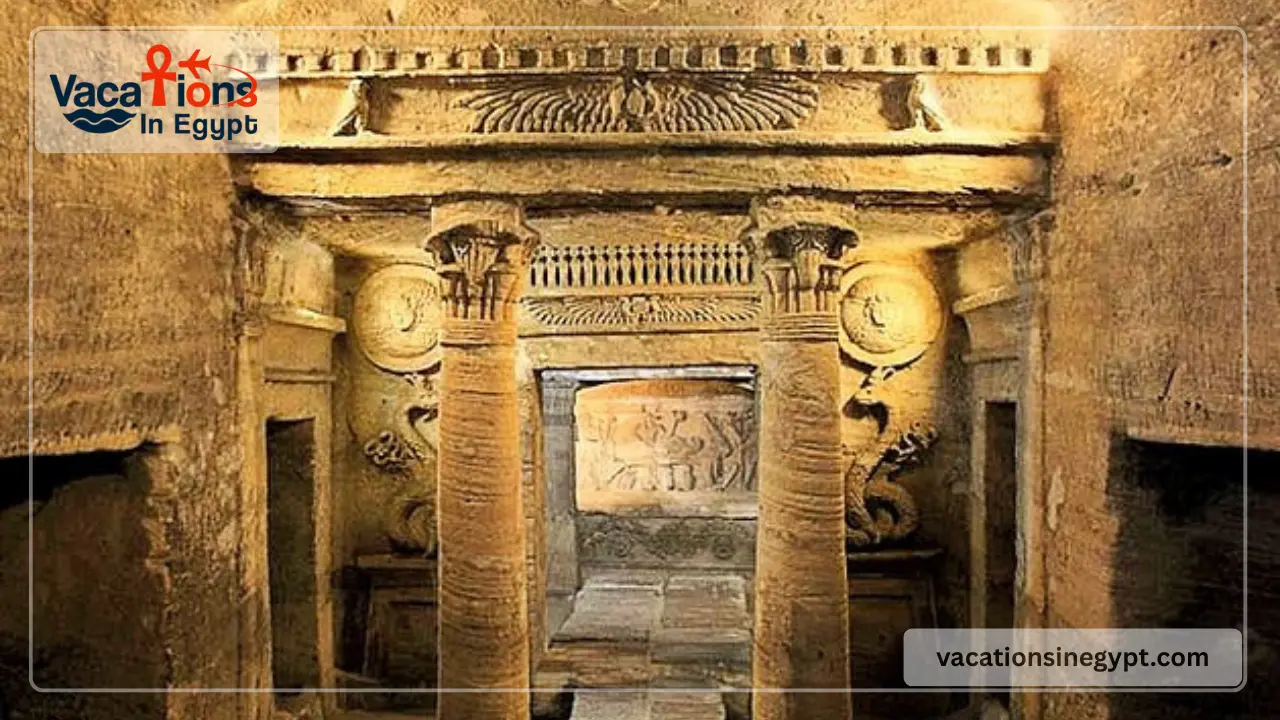
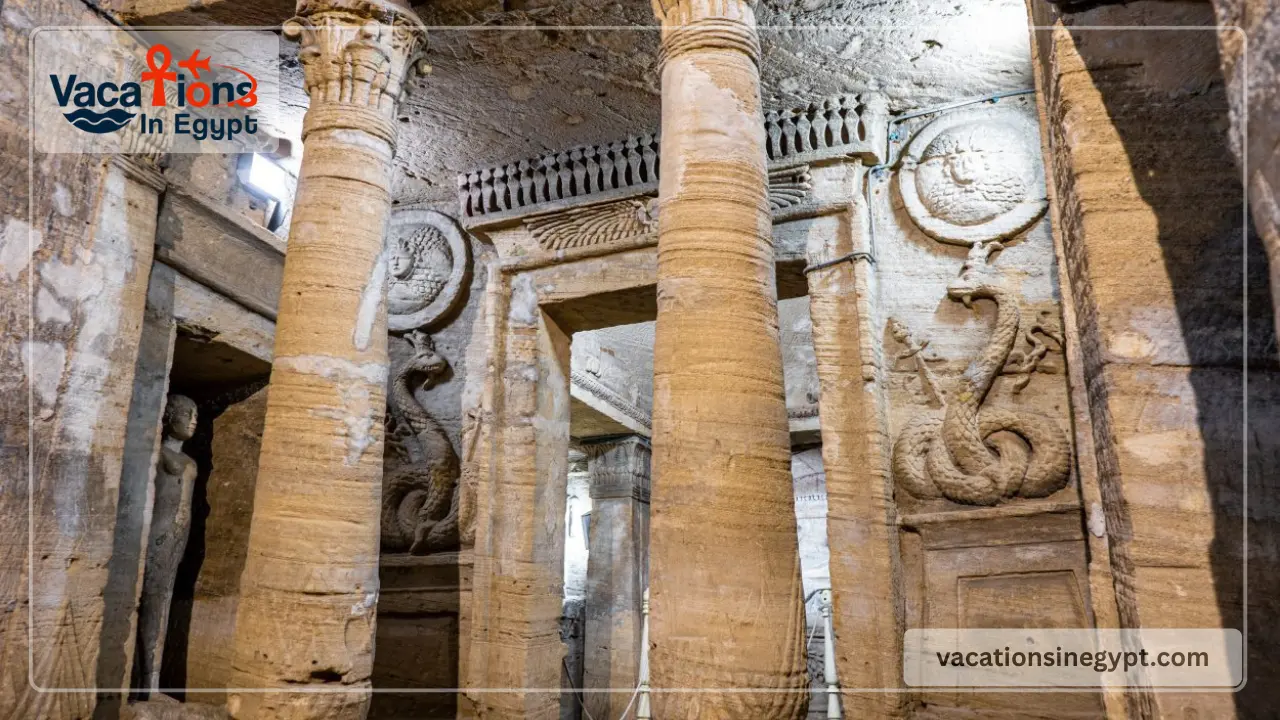
The most striking feature of the catacombs is the artistic decorations. The bas-reliefs carved into the walls show a unique fusion of iconography that you cannot find anywhere else in the world.
- The Guardians: On both sides of the burial chamber entrance, two giant serpents represent the Greek “Agathodaimon,” yet they wear the Double Crown of Egypt (Pschent).
- Medusa and Athena: Above the serpents, shields feature the head of Medusa to ward off evil, a distinctly Greek theme.
- Anubis: Inside, the Egyptian god of the dead, Anubis, is depicted standing guard. However, instead of traditional Egyptian attire, he is dressed in the armor of a Roman legionnaire.
Top Facts About the Catacombs of Kom El Shoqafa
- The Name: It is technically a “kata komp”—a term for underground tunnels that became the standard definition for catacombs in the first three centuries A.D.
- Capacity: The complex contains niches for over 300 bodies, encompassing sarcophagi, shelf tombs, and urns for cremation ashes.
- Lighting: In the upper vestibules, you can still see the niches carved into the walls where oil lamps were placed to light the way for visitors two thousand years ago.
Planning Your Visit to Alexandria’s Greco-Roman Necropolis
If you are a fan of history and ancient civilizations, a vacation in Alexandria is incomplete without visiting this site. It stands as a testament to the cosmopolitan nature of ancient Alexandria, where Pharaonic beliefs met Roman architecture.
- Location: The site is located in the Karmouz district, just a short walk south of Pompey’s Pillar.
- Tip: Wear comfortable shoes, as the spiral staircase is deep, and the air can be humid underground.